How to Choose the Best Agricultural Forklift?
Choosing the best Agricultural Forklift starts with the work, not the brochure. Farms present uneven ground, narrow storage areas, mud, dust, and changing loads. A forklift that performs well on concrete may struggle beside a wet barn. Ground conditions change.
Before comparing brands, identify the daily tasks. Record typical pallet weights, lifting heights, travel distances, and attachment needs. Hay bales, fertilizer bags, feed pallets, and crates may require different handling approaches. Measure doorways and turning areas carefully. One overlooked beam can make a capable machine impractical.
Field experience shows that stability, visibility, and service access deserve equal attention. Pneumatic tires can improve movement across rough surfaces. A suitable mast height can prevent contact with low roofing. Operators also need clear sightlines when carrying bulky loads. Ask how quickly filters, tires, and hydraulic components can be inspected. Downtime during harvest is expensive.
Engine power matters, but it should match the workload. Excess capacity may increase fuel use and purchase costs. Insufficient capacity can create unsafe handling and premature wear. No checklist is perfect. Seasonal weather, operator habits, and changing crops may expose weaknesses later. For that reason, request a practical demonstration with representative loads. Review the manufacturer’s specifications, maintenance guidance, warranty terms, and local safety requirements. Reliable dealers should explain limitations, not only advantages. The strongest choice balances performance, operator confidence, durability, and total ownership cost. It may not be the largest Agricultural Forklift available. It should be the one that works safely, consistently, and economically on your farm.
What Makes an Agricultural Forklift Different?
How to Choose the Best Agricultural Forklift?
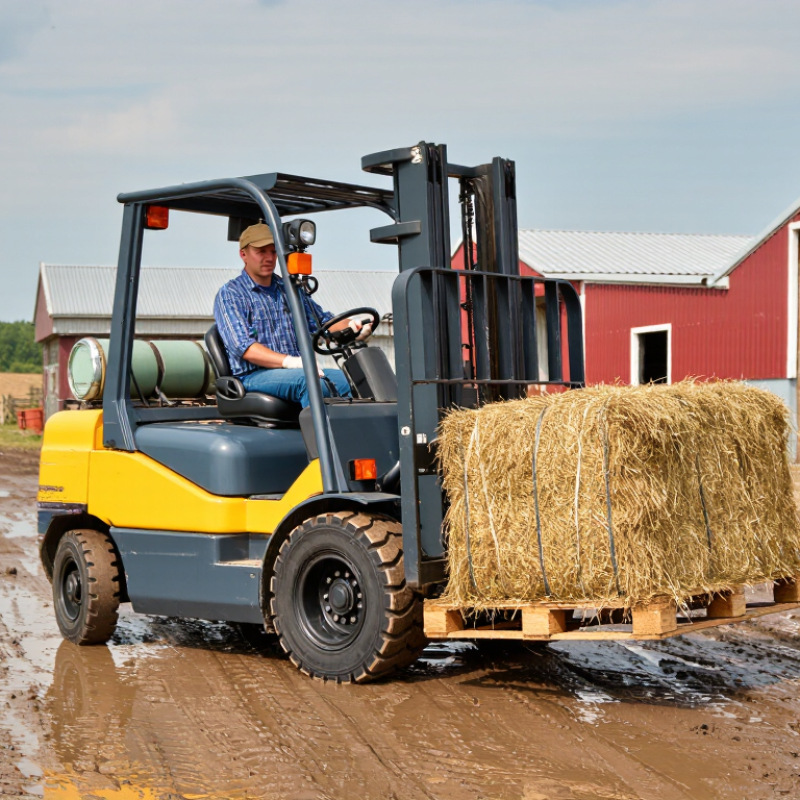
An agricultural forklift works in conditions that standard warehouse trucks rarely face. Mud, gravel, slopes, rain, and uneven concrete change the safety calculation. Pneumatic tires usually provide better field traction than cushion tires. Higher ground clearance also helps prevent frame damage near irrigation channels and crop rows. However, larger tires can reduce stability when loads are raised. That trade-off is easy to underestimate.
OSHA estimates that powered industrial trucks cause about 85 fatal injuries and 34,900 serious injuries annually in the United States. Its Powered Industrial Trucks guidance repeatedly emphasizes stability, load capacity, and operator training. These points matter even more on farms, where pallets may contain wet feed, fertilizer bags, or irregular produce crates. Choose capacity by the real load center, not only the advertised maximum weight. Attachments can move the load center forward. Capacity drops.
A practical inspection should examine mast visibility, braking response, tire condition, and hydraulic leaks. Corrosion protection matters around washdown areas. So does engine performance during long outdoor shifts. Electric models can reduce local exhaust emissions, but charging infrastructure may be unreliable in remote sheds. Diesel or gas systems may offer longer operating time, yet ventilation becomes critical. There is no perfect setup. A forklift that handles neatly on Tuesday may struggle after heavy rain. I would test it on the actual farm surface, with the heaviest realistic load, before making a purchase.
How to Match Forklift Capacity to Farm Tasks
How to Choose the Best Agricultural Forklift?
A forklift’s rated capacity is not the same at every lifting height. Farm tasks often involve uneven ground, long loads, and shifting weight. A 2,500-kilogram rating may apply only at a specific load center and mast height. Check the capacity plate before planning daily work.
Measure the heaviest load first. A wrapped hay bale may weigh 700 kilograms, while a fertilizer pallet can exceed 1,000 kilograms. Add the attachment’s weight to the load. Then consider the load center, especially with long pipes, wide bins, or extended forks. As the load moves farther forward, usable capacity falls. Keep a practical safety margin rather than operating at the limit.
Height matters too. Loading a trailer requires more stability than moving feed across a yard. Rough surfaces, slopes, and wet soil increase the risk of tipping. Choose tires and ground clearance for the farm’s actual conditions. An experienced operator should test steering, braking, visibility, and mast movement with a controlled load. Do not rely on brochure figures alone. They can be too optimistic. In field checks, small details often change the decision, such as a narrow doorway or a slippery concrete floor. Recheck capacity after adding a bale clamp or other attachment. A forklift that handles the load comfortably is usually more useful than one that only meets the minimum number.
Which Power Source Fits Your Agricultural Setting?
How to Choose the Best Agricultural Forklift?
Which Power Source Fits Your Agricultural Setting?
Power source should follow the farm’s work pattern, not fashion. Electric forklifts suit enclosed barns, food-storage rooms, and quiet night shifts. They produce no exhaust at the point of use. That matters around animals, workers, and stored crops. The U.S. Department of Energy’s Alternative Fuels Data Center identifies electricity, propane, natural gas, and diesel as common fleet fuels. Each option changes refueling time, maintenance, ventilation, and operating cost.
Battery charging needs planning. A forklift moving pallets beside a cold store may need a spare battery or scheduled breaks. The International Energy Agency reported more than 14 million electric cars sold globally in 2023. This signals a growing battery supply chain, but farm charging infrastructure can still be weak. A simple socket is not always enough. Check electrical capacity first.
Diesel or propane can fit muddy yards, steep lanes, and long outdoor shifts. Yet fuel storage, fumes, and noise deserve serious attention. OSHA estimates that forklifts cause about 85 U.S. workplace fatalities and 34,900 serious injuries annually. Visibility and stability matter more than advertised power. Measure the heaviest load, travel distance, surface condition, and daily hours. Electric may be cleaner, but it is not automatically better. A short field trial often exposes uncomfortable assumptions.
How to Choose the Best Agricultural Forklift?
Which Power Source Fits Your Agricultural Setting?
The chart shows representative uninterrupted operating-time ranges for common forklift power sources. Actual runtime depends on load, terrain, attachments, temperature, maintenance, and duty cycle.
Diesel: Suitable for heavy outdoor work, uneven ground, and long shifts where rapid refueling is important.
LPG: A flexible option for mixed indoor and outdoor operations, with quick cylinder replacement and relatively low downtime.
Lead-acid electric: Best for cleaner, quieter areas when scheduled charging and battery changes can be managed.
Lithium-ion electric: Well suited to frequent-use operations that can take advantage of opportunity charging and lower routine maintenance.
How to Choose Tires, Attachments, and Ground Clearance
How to Choose the Best Agricultural Forklift?
Tire selection should begin with the ground, not the showroom. Pneumatic tires absorb stones and shallow ruts across rough fields. Solid tires resist punctures but can transmit stronger shocks to the operator and load. On wet clay, traction can disappear quickly. Choose deep, self-cleaning tread when mud is common. Check the tire load rating against the forklift’s maximum capacity, especially near the rear axle.
Attachments change the forklift’s balance and lifting behavior. A bale spear, bucket, or clamp moves the load center forward. That reduces practical capacity, even when the load weighs less than the rated limit. Match each attachment to the carriage, locking system, and hydraulic flow. Keep heavy loads low during travel. I once underestimated how far a bulky bale extended forward. The machine felt stable, but steering became slower. That mistake deserved more planning.
Ground clearance matters on rutted lanes and harvested fields. Measure the lowest point beneath the axle, frame, and attachment. High clearance helps prevent contact with ridges, stones, and buried crop residue. However, extra clearance can raise the center of gravity. Inspect the route before carrying a tall load. Leave room for suspension movement and uneven turns. Farm lanes are rarely level.
