
What Are the Top 10 PE Gas Pipe Manufacturers in China?
China’s PE Gas Pipes sector combines large-scale production, advanced extrusion lines, and strong export capability. Yet size alone does not prove reliability. This guide examines ten leading Chinese manufacturers through practical criteria, including resin quality, dimensional control, pressure testing, fusion performance, traceability, and project experience.
David Fink, a recognized polyethylene piping specialist and former president of the Plastics Pipe Institute, has emphasized: “Polyethylene pipe is a proven, reliable, and cost-effective choice for gas distribution.” His point remains useful, but product quality still depends on manufacturing discipline and installation practice. A pipe can meet a technical standard and still perform poorly when storage, joining, or inspection is neglected.
The manufacturers reviewed here are assessed against relevant requirements, such as ISO 4437 and applicable Chinese standards, including GB/T 15558. Attention is also given to SDR ranges, PE80 and PE100 materials, factory testing, certification records, and after-sales support. Some companies appear strong in municipal gas projects, while others show better export documentation or custom production capacity. That difference matters.
This is not an official government ranking. Supplier data, certifications, and factory capabilities can change. Buyers should verify current documents directly. That step is often missed. Site visits, sample testing, and reference checks may reveal weaknesses that brochures hide. The final list therefore aims to be useful, not absolute, helping engineers, distributors, and project owners compare Chinese PE Gas Pipes manufacturers with greater confidence and a more critical perspective.
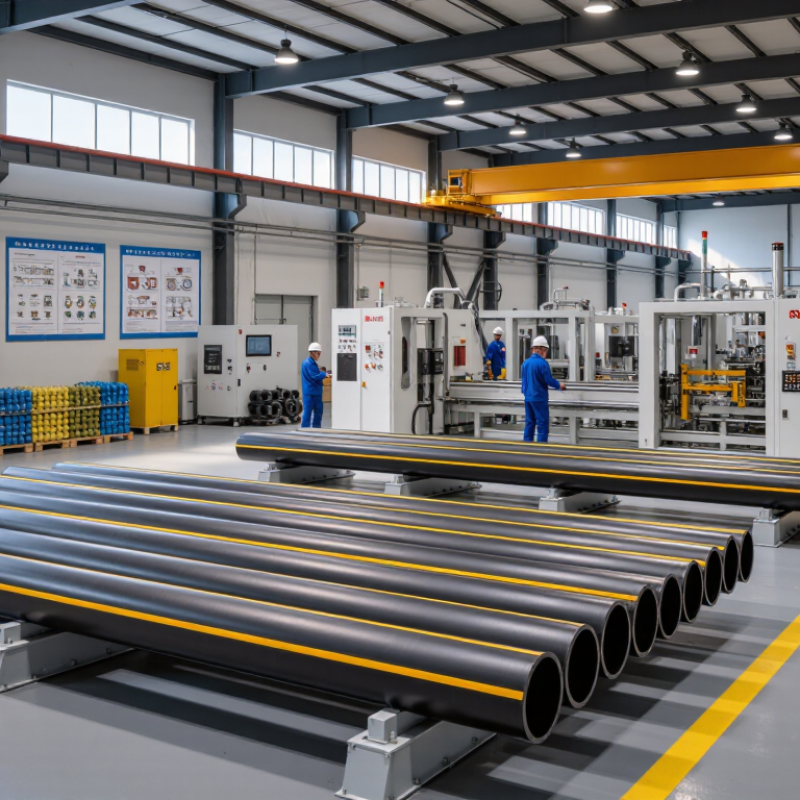
What PE Gas Pipes Are and How They Are Used
PE gas pipes are made from polyethylene, a tough, flexible thermoplastic used in underground gas distribution. Their flexibility helps them follow gentle bends and reduces the need for extra fittings. Unlike metal, polyethylene does not rust when exposed to damp soil. The pipe is usually black, often with yellow markings, but color alone cannot confirm its intended service. Check product documentation.
Installers join sections using approved fusion methods, creating a continuous connection when the process is performed correctly. Pipes must match the required diameter, pressure rating, and operating conditions. They are commonly buried in prepared trenches, where bedding material helps protect them from sharp stones. Soil movement can still cause problems. That detail is easy to underestimate.
Tips: Keep pipes away from sharp debris during handling. Have qualified professionals select, join, and inspect the system. Follow the pipe maker’s specifications, and check for scratches or crushing before installation. Never assume a flexible pipe is suitable for every site; local conditions and system design matter.
How to Evaluate China’s PE Gas Pipe Manufacturers
A low quotation tells little about long-term performance. Check whether the manufacturer’s PE gas pipes meet the applicable edition of ISO 4437 and China’s GB/T 15558 series. Ask for certificates, test reports, and traceable production-batch records. Verify that reports identify the same resin grade, diameter, and wall thickness as your order. Small mismatches matter.
The International Energy Agency’s Gas 2024 report estimated global gas demand grew by about 2.8% in 2024, with much of the increase in Asia. That context makes dependable supply planning important, but demand growth is not proof of a supplier’s quality. Review resin sourcing, dimensional inspection, pressure-test procedures, and capacity records. Request a factory audit or a live production walkthrough. A sample alone cannot reveal process consistency.
Tips: Ask for a recent third-party test report and confirm its issuing laboratory independently. Compare delivery records and complaint handling, not just price. One detail is easy to miss: clarify storage and transport conditions, since prolonged sunlight exposure can affect pipe surfaces. Then document acceptance criteria before production begins.
What to Check When Evaluating China’s PE Gas Pipe Manufacturers
A material-grade reference for assessing product documentation. Verify the declared PE classification against applicable standards and independent test reports; these figures are not manufacturer ratings.
MRS values: PE63 = 6.3 MPa, PE80 = 8.0 MPa, and PE100 = 10.0 MPa. MRS means Minimum Required Strength, classified under ISO 12162. Confirm the relevant pipe-system requirements and test conditions for the intended application.
Profiles of Ten Notable PE Gas Pipe Manufacturers in China
China’s PE gas-pipe sector includes producers with different strengths. The China Plastics Processing Industry Association reported roughly 16.2 million tonnes of plastic-pipe output in 2023. That figure covers multiple polymers and uses; it is not a measure of gas-pipe production. ISO 4437 provides a technical reference for polyethylene piping systems used to supply gaseous fuels.
Ten useful profiles reflect the range of capabilities buyers may encounter: integrated resin-and-pipe producers; gas-network specialists; large-diameter pipe makers; urban utility suppliers; rural distribution contractors; fitting manufacturers; extrusion-focused plants; traceability-led producers; trenchless installation suppliers; and export-oriented engineering firms. Their strengths differ. Some emphasize consistent dimensions and fusion compatibility, while others prioritize regional delivery or project support. These are capability profiles, not a ranking of named companies.
For a practical comparison, review compound documentation, production controls, pressure-class options, and batch records. Ask how a supplier handles dimensional checks and material testing. Look for clear evidence, not broad claims. A polished catalogue can still leave gaps. I would also verify whether a stated product range is actually made at the facility being assessed; that detail is easy to overlook.
What Are the Top 10 PE Gas Pipe Manufacturers in China?
Anonymous comparison framework for assessing manufacturers. The entries below summarize verifiable product standards and technical benchmarks; they are not company-specific claims, a confirmed ranking, or a substitute for checking current product certificates and test reports.
| Profile | Evaluation Dimension | Factual Benchmark | What Buyers Should Verify |
|---|---|---|---|
| 01 | Pipe standard | GB/T 15558.1-2015 specifies requirements for polyethylene pipes used in gaseous-fuel supply systems. | Confirm the exact standard and edition stated on product documentation and certificates. |
| 02 | Fittings standard | GB/T 15558.2-2015 covers polyethylene fittings for gaseous-fuel supply systems. | Check that the proposed fittings are suitable for the pipe material, dimensions, and joining method. |
| 03 | PE100 material classification | PE100 has a minimum required strength (MRS) of 10 MPa under the applicable material-classification system. | Request material identification and supporting test documentation for the supplied production batch. |
| 04 | PE80 material classification | PE80 has an MRS of 8 MPa under the applicable material-classification system. | Confirm that the selected material class matches the project design and applicable local requirements. |
| 05 | SDR and pressure rating | For PE100 at 20°C, SDR11 corresponds to a nominal pressure rating of 1.0 MPa when a design coefficient of 2.0 is applied. | Verify the pressure class, design coefficient, operating temperature, and project-specific design rules. |
| 06 | Higher SDR comparison | Using the same PE100 material and design coefficient, SDR17 corresponds to a nominal pressure rating of 0.625 MPa at 20°C. | Compare the marked SDR and pressure rating with the approved system design; do not infer suitability from SDR alone. |
| 07 | Dimensions and tolerances | Pipe dimensions and tolerances are specified by the applicable product standard and depend on nominal outside diameter and wall thickness. | Check measured dimensions, dimensional markings, and consistency with the purchase specification. |
| 08 | Joining compatibility | PE gas systems commonly use butt fusion or electrofusion; joining procedures must be appropriate for the pipe and fittings. | Review approved procedures, equipment calibration records, operator qualifications, and joint inspection records. |
| 09 | Quality and batch traceability | Traceable production records help link a pipe to its material, manufacturing batch, and inspection results. | Request legible pipe markings, batch records, inspection documents, and a process for handling nonconforming products. |
| 10 | Type testing and compliance evidence | Compliance should be established against the standards and regulatory requirements applicable to the intended market and project. | Validate certificate scope, issuing body, product range, validity, and independent test reports before procurement. |
Comparing Product Ranges, Standards, and Manufacturing Capabilities
Choosing among China’s leading PE gas pipe manufacturers requires more than comparing catalog size. A broad product range may include different diameters, wall thicknesses, pressure ratings, and pipe fittings. Check whether the supplier can provide consistent specifications across these options. Ask for current test reports and traceable production records. Details matter.
Standards and manufacturing capability deserve equal attention. Confirm that products meet the project’s stated technical requirements, and verify certificates directly with the issuing body. Review resin sourcing, extrusion controls, dimensional checks, and batch testing. A factory visit or documented audit can reveal how quality checks work on an ordinary production day. Capacity claims alone are not enough. Delivery performance, technical support, and the ability to handle custom lengths also affect project reliability. Even a polished brochure cannot replace evidence; I would treat vague answers as a reason to ask more questions.
Tips: Compare suppliers using the same checklist: product range, applicable standards, test documentation, output capacity, and lead time. Request sample records before placing an order. Then verify that the quoted specifications match the project drawings.
Key Factors for Choosing a PE Gas Pipe Supplier
Choosing a PE gas pipe supplier requires more than comparing prices. Check that the manufacturer can provide traceable material records, consistent production data, and test results for the pipe dimensions and pressure rating you need. Ask how quality checks are recorded, from incoming resin to finished coils. Clear answers matter.
Look closely at manufacturing experience with gas applications, not just general plastic piping. Request relevant certificates and verify their scope and validity with the issuing body. Also ask about batch identification, storage conditions, delivery protection, and technical support after shipment. A scratched pipe or poorly protected coil can create problems before installation even begins.
Visit the production site if practical. Observe how samples are measured and whether records match the actual product. Small gaps in documentation are easy to overlook. I would not treat a polished brochure as proof; independent checks and specific questions give a more reliable picture.
Article Source:
We Meet Our Clients Needs.
Meeting the diverse needs of our clients, we have complete machining facilities for everything from single part prototypes to large quantity production. Our small size is one of our biggest assets. It allows us to control costs and maintain the highest of standards.
Quality orientated and delivery always on time or earlier than originally promised.
Strongly recommend MSD.