
Why Choose TWS Wireless Earbuds for Your Business?

Businesses rely on clear communication, steady audio, and tools that fit changing workdays. Tws Wireless Earbuds can support calls, online meetings, training sessions, and focused work without a cable crossing the desk. For a sales team, that might mean taking a call while checking product notes. For a warehouse supervisor, a comfortable fit and dependable connection may matter more than stylish packaging. Small details count.

Choosing a model requires more than comparing prices. Battery life, microphone clarity, Bluetooth stability, comfort, and charging options all affect daily use. Test earbuds with the devices and apps your team already uses. Listen in a quiet room, then try a realistic call with ordinary background noise. A specification sheet cannot tell the whole story. That is worth remembering.

There are trade-offs. Earbuds can be misplaced, need regular charging, and may not suit every employee for long wear. Some microphones also perform poorly in busy spaces, even when product descriptions sound impressive. A small pilot can reveal these issues before a larger purchase. Ask staff for specific feedback, such as whether voices sound natural or controls are easy to use. The right choice depends on the job, the user, and the support available. A careful evaluation can help businesses find practical value without assuming one model works for everyone.
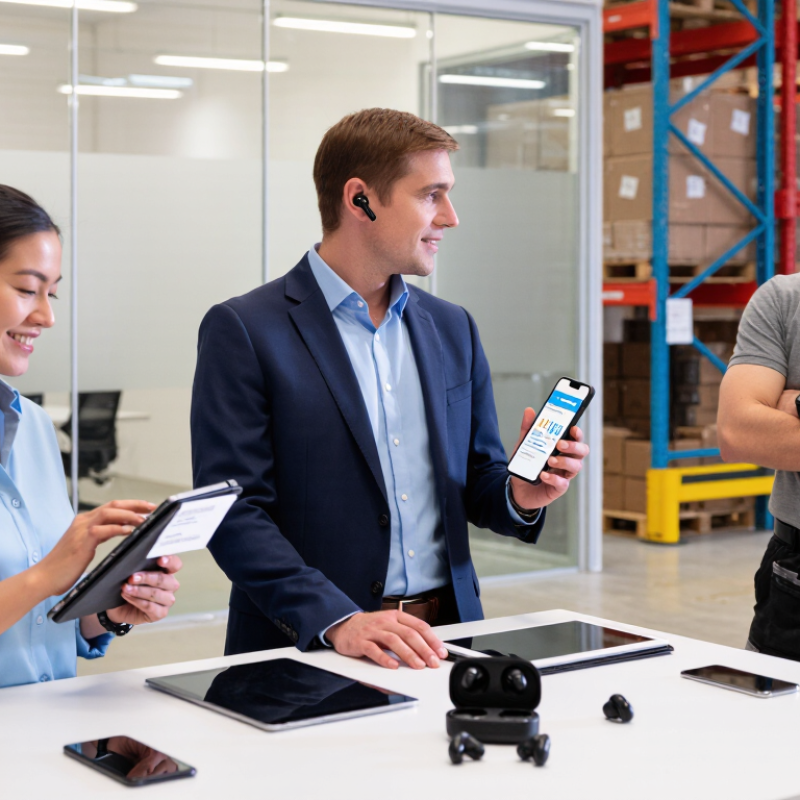
Why Choose TWS Wireless Earbuds for Your Business?

What Defines TWS Earbuds and How Do the Two Earpieces Connect?

TWS means true wireless stereo: two separate earpieces with no cable between them or to the phone. Each earpiece contains a speaker, microphone, battery, and wireless radio. During setup, the phone usually pairs with the earbuds as one audio system. In many designs, one earpiece receives the audio and relays it to the other; some newer designs support separate, synchronized streams. Bluetooth LE Audio’s Multi-Stream Audio feature is designed for this kind of synchronized connection. The exact arrangement depends on the product. A crowded office matters.

The practical result is that both earpieces can play together while each microphone captures speech. But walls, nearby wireless devices, and fit can affect performance. Canalys reported that global TWS shipments reached 65 million units in the first quarter of 2024, up 6% year over year. This shows the category’s scale, not how well any particular model will work in a meeting. Bluetooth SIG’s 2024 market update forecast 7.5 billion Bluetooth device shipments annually by 2028, across product types. For business buyers, check call stability, device switching, battery life, and whether either earpiece works alone. Pairing should feel simple. Still, specifications cannot fully predict performance in a busy room.

Why Does TWS Matter as Bluetooth SIG Projects 7.6 Billion Annual Shipments by 2027?

Bluetooth SIG projects 7.6 billion annual Bluetooth device shipments by 2027. This is a broad ecosystem forecast, not a prediction that every shipment will be an earbud. Still, it signals how familiar wireless connectivity may become in workplaces, retail spaces, and customer service.

For businesses, true wireless stereo (TWS) earbuds can support hands-free calls, staff training, and mobile work. A shop employee might take a call while checking stock, without managing a cable. Small details matter: clear microphones, stable pairing, comfortable fit, and dependable battery life. Convenience disappears quickly when earbuds disconnect during a customer conversation.

The forecast offers context, not a guarantee of demand. Businesses should match features to real tasks and test products across their own devices. Check call quality in a busy room, charging routines during long shifts, and how easily staff can pair earbuds. Not glamorous, but useful. Even strong market growth cannot fix poor fit or unclear audio. A small pilot with several employees can reveal issues that a product sheet may miss.

Why Choose TWS Wireless Earbuds for Your Business?

Bluetooth SIG projects 7.6 billion Bluetooth device shipments annually by 2027.

This projection covers Bluetooth devices overall—not TWS earbuds alone. It signals a growing Bluetooth ecosystem that businesses can consider when evaluating wireless audio products.

Source: Bluetooth SIG market projection.

Which Business Workflows Benefit Most from TWS Audio and Calls?

TWS wireless earbuds help most when work moves between conversations, screens, and locations. Customer-support teams can answer calls while checking order details on a laptop. Sales staff can walk between meeting rooms without holding a phone. Field technicians can hear instructions while keeping their hands available for tools. Small details matter. A stable fit and a clear microphone can make a long shift easier, but performance varies with noise, device settings, and earbud design.

Tips: Test calls in the actual workspace, not just a quiet office. Check how easily earbuds switch between a computer and phone. Keep a charging case nearby, and confirm the microphone sounds clear during ordinary speech.

Remote interviews and hybrid meetings also benefit from TWS audio. Staff can move briefly to retrieve a document without leaving the conversation. Training teams can listen to short lessons while reviewing materials, though earbuds should not replace a proper speaker setup for group instruction. For warehouse or reception work, background sounds may still mask speech. A quick trial during a busy hour can reveal problems a product sheet will not. Teams sometimes focus too much on battery life and overlook comfort; that’s an easy mistake to make.

How Do Battery Life, Microphones, and Device Compatibility Affect Performance?

Why Choose TWS Wireless Earbuds for Your Business?

Battery life affects more than comfort; it can interrupt calls, shifts, and customer support. Check quoted listening time against your team’s real schedule, including call volume and microphone use. A charging case helps, but it does not fix earbuds that die before a long shift ends. The Bluetooth SIG’s 2024 Market Update projects 7.5 billion Bluetooth device shipments annually by 2028, reflecting how widely wireless devices are expected to be used. That scale makes reliable charging and easy replacement practical purchasing concerns.

Microphones matter in noisy offices, warehouses, and shared meeting rooms. Look for clear voice pickup and noise reduction, then test both with a colleague several metres away. Record a short call beside a ventilation fan. Can the listener understand names and numbers? This simple test reveals more than a feature list. Noise reduction can also make voices sound unnatural. A small trade-off, perhaps, but worth checking.

Compatibility should be tested across the actual laptops and phones employees use. Confirm pairing, call controls, and switching between devices; Bluetooth support alone does not guarantee every feature works equally well. Before a bulk order, test a few units during a full workday and note dropouts, comfort, and charging habits. Specs are useful. Real use can disagree.

Sources: Bluetooth SIG, 2024 Market Update; device compatibility guidance from Bluetooth SIG.

What Should Businesses Assess for Security, Durability, and Total Cost?

Why Choose TWS Wireless Earbuds for Your Business?

When evaluating TWS earbuds, assess security, durability, and total cost together. Ask how devices pair, whether pairing can be restricted, and how firmware updates are delivered. Check the supplier’s security documentation rather than relying on broad claims. Test call quality in the places employees actually work: a shared office, a busy reception area, or beside a humming air conditioner. Test them on-site. A quiet showroom can hide microphone problems.

Tips: Record battery life during a typical shift, not just in a short demo. Check the stated water- and dust-resistance rating, cleaning guidance, warranty, and replacement-part availability. Confirm how easily staff can identify and reconnect their assigned earbuds.

For total cost, include charging cases, replacements, support, and time spent troubleshooting—not only the purchase price. A lower-cost set may become expensive if batteries fade quickly or fit varies across users. A small pilot can reveal these issues before a larger order. Still, no checklist catches everything; employees may use earbuds differently than expected. Review feedback after several weeks and adjust your selection criteria.

Why Choose TWS Wireless Earbuds for Your Business? — What Should Businesses Assess for Security, Durability, and Total Cost?
Use these practical checks to compare true wireless stereo (TWS) earbuds for business use. Suggested targets are procurement guidelines, not universal requirements; confirm performance and certifications for the exact model and operating conditions.
Assessment area What to assess Evidence or practical check Why it matters to a business
Bluetooth security Pairing controls, supported Bluetooth security features, and how previously paired devices are removed or reset. Review the product’s security documentation and test pairing, unpairing, and factory reset procedures. Do not assume every Bluetooth product implements security features identically. Reduces avoidable connection and device handover risks, especially for shared equipment.
Firmware and administration Firmware update process, update support period, user permissions, and whether a companion app or account is required. Ask how updates are delivered, whether update instructions are documented, and what data any app collects. Check compatibility with company mobile-device policies. Makes ongoing maintenance and privacy review more predictable.
Multipoint and device compatibility Supported operating systems, call-platform behavior, Bluetooth multipoint support, and switching between work devices. Test with the organization’s actual laptops and phones. Verify that multipoint works as expected; support and behavior can vary by model and device combination. Fewer connection problems can reduce setup delays and support requests.
Ingress protection The stated IP rating for earbuds and charging case, if provided, and the conditions covered by that rating. Check the rating against IEC 60529 documentation. For example, IPX4 indicates protection against water splashes under specified test conditions; it does not mean the product is waterproof or suitable for immersion. Helps match the product to commuting, office, or light-workout use without overstating its protection.
Physical durability Case hinge and lid strength, charging-port design, fit, and resistance to routine handling. Inspect samples and review documented test methods or warranty exclusions. If devices will be shared, trial them through the expected cleaning and handling routine. A realistic trial can reveal wear points that specifications alone may not show.
Battery and daily runtime Earbud runtime per charge, charging-case capacity, recharge time, and performance with features such as active noise cancellation enabled. Compare published test conditions and run a workday trial. Battery life varies with volume, calls, radio conditions, and enabled features. A practical runtime check helps prevent mid-shift charging interruptions.
Comfort and hygiene Fit options, comfort over extended wear, replaceable ear tips, and approved cleaning guidance. Offer a representative user trial and confirm that replacement tips are available. Follow manufacturer cleaning instructions, particularly for shared devices. Comfort and a workable cleaning process can improve adoption and support responsible sharing.
Warranty and repairability Warranty duration and exclusions, availability of replacement parts, and options for replacing a lost or failed earbud or case. Obtain written warranty terms and current replacement-part pricing before purchase; confirm local service availability. Clear replacement terms make failure costs easier to estimate.
Total cost of ownership Purchase price plus accessories, replacement units, support time, shipping, and any required app or service fees over the evaluation period. Compare: total cost = purchase + accessories + replacements + support and service costs − confirmed discounts or credits. Use the same time period and assumptions for every option. A consistent calculation is more informative than comparing purchase price alone.
Pilot and acceptance criteria Call quality, connection reliability, comfort, battery performance, and support effort in real work settings. Run a small pilot with representative users and devices. Record issues and agree on pass/fail criteria before placing a larger order. Validates suitability in the organization’s environment before wider deployment.
Procurement note: Treat manufacturer specifications as claims to verify. Confirm applicable safety, privacy, and workplace requirements for the intended deployment.

We Meet Our Clients Needs.

Meeting the diverse needs of our clients, we have complete machining facilities for everything from single part prototypes to large quantity production. Our small size is one of our biggest assets. It allows us to control costs and maintain the highest of standards.

Quality orientated  and delivery always on time or earlier than originally promised.

Strongly recommend MSD.